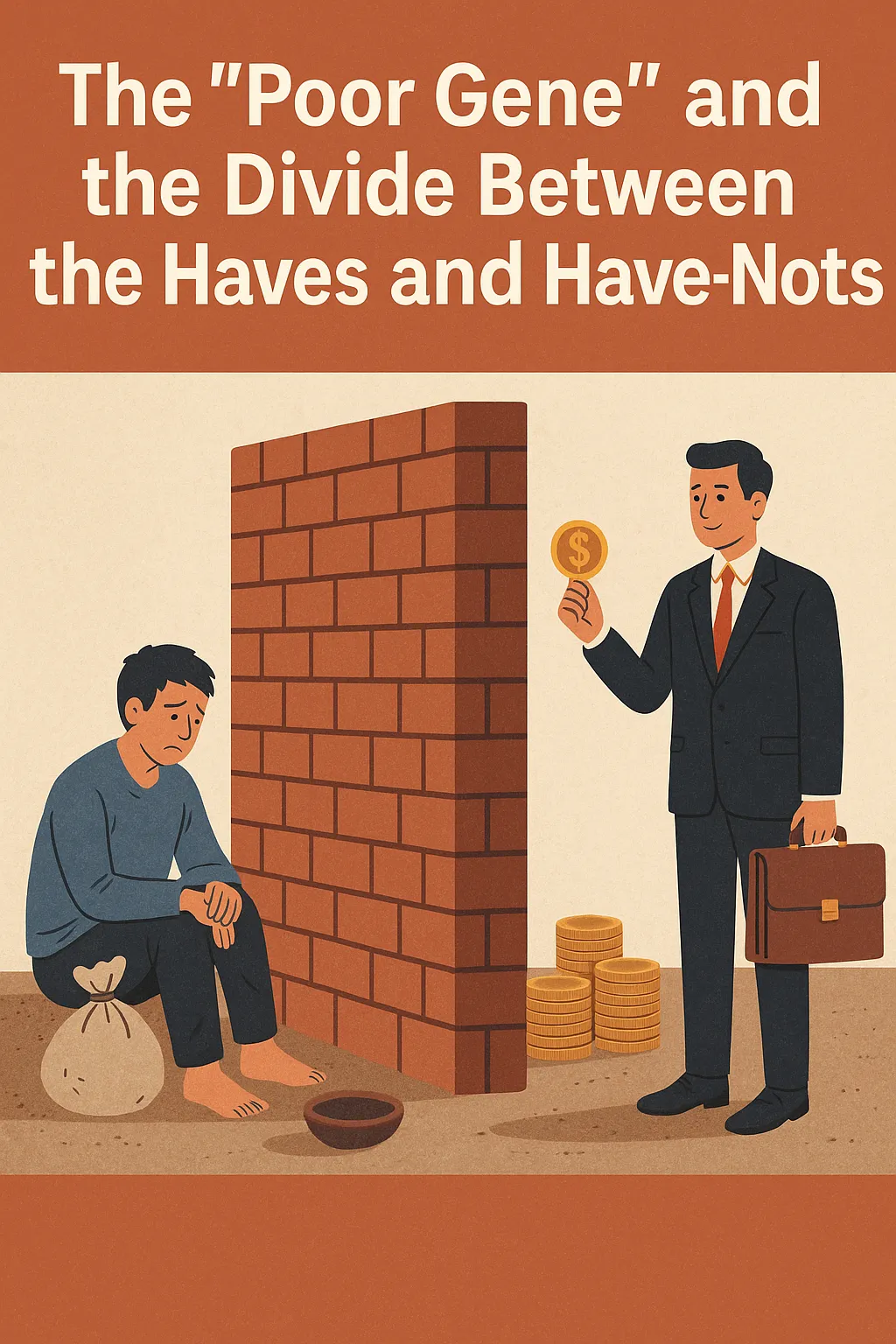
T.J. Scott explores the concept of the ‘Poor Gene’—a metaphor for inherited struggle, mental roadblocks, and what separates the Haves from the Have Nots.
The truth is, we are shaped by our genetics, our environment, and the choices we make. But the question that often lingers is: Are we born with traits that limit our potential for prosperity? In the context of the “Haves” and the “Have Nots,” it’s not just about what we have physically, our possessions, our wealth, or our opportunities, but about how we navigate the world around us and whether we can overcome the internal and external barriers that threaten our success.
There’s a metaphor that I want to explore, one that I call the “Poor Gene.” It’s not a literal gene, there is no specific DNA that dictates poverty or wealth, but it’s a concept that speaks to the mental, emotional, and psychological traits that are often inherited or learned. The Poor Gene is about the traits that may make one person more prone to struggle, whether it’s in the areas of financial literacy, cognitive development, emotional resilience, or even interpersonal relationships.
The reality is that many of us are born into circumstances that feel like an uphill battle. We might have inherited traits that make certain challenges harder to face, whether that’s difficulty with memory, lack of confidence, or a predisposition toward depression and anxiety. These internal factors can make it feel like we are always a few steps behind, like the odds are stacked against us from the start.
It’s easy to point to excuses. “I was born into poverty.” “I wasn’t given the same opportunities.” “My family didn’t teach me how to manage money.” And while these external factors certainly play a role, there’s something deeper that must be considered. Are we born with traits that stiffen the possibility of prosperity? Are we predisposed to failure? Is there a “Poor Gene” that keeps us from moving forward, no matter how hard we try?
At the heart of this concept is a question of personal responsibility. We can spend our entire lives looking for excuses, blaming our circumstances, or pointing fingers at the past. But does it lie within us to make the change? Does the power to shift our lives lie in the choices we make, even when the world around us seems to be against us?
The concept of generational curses often comes up when discussing poverty. We inherit the struggles of our parents, their financial habits, their mindset, and even their emotional baggage. But is it more than that? Could it be that the traits we inherit, like our ability to navigate the world or our way of processing emotions, play a bigger role in our success or failure?
We often try to push off the blame for our own inadequacy, thinking that “if only I had more resources, more help, or more luck,” we would succeed. But the truth is that success often comes down to the inner drive to break the cycle. And sometimes, that inner drive has to be cultivated from the ground up.
This leads us to the age-old debate: Nature vs. Nurture. What role does genetics really play in our ability to succeed? We can all agree that circumstances matter, what we are exposed to, how we are raised, and what opportunities we have access to, but it’s also true that nature plays a role in shaping who we are.
In my case, I can trace certain patterns, traits passed down from my parents, that made it harder for me to succeed. But I also had a strong desire to break free from those patterns, to rewrite the story that had been written for me before I even had a say in the matter.
Some people are born with natural resilience, an ability to learn quickly, and an ease with numbers and problem-solving. They might be the ones who seem to always land on their feet, who seem to understand the world of finance or business with little effort. But for others, the process is much more difficult. It takes extra work, extra focus, and sometimes a lot of self-doubt to get ahead.
But even though genetics plays a part, it’s important to recognize that we are not prisoners of our genes. While our inherited traits may influence us, they don’t have to define us. It’s up to us to make goals, but also to make plans. A goal without a plan is just a destination. And while things don’t always go according to plan, being willing to pivot and adapt is what makes the difference between those who succeed and those who don’t.
This is where the real change happens. It’s in the small, consistent steps we take every day. It’s in valuing what we have, even the little things, and using those things to build for something bigger. For me, it was my journals, my written memories, the proof of my existence. These small possessions represented something far beyond their physical form, they were my connection to my story, my past, and my future.
But the truth is, what I value may not be what someone else values. What we hold of value doesn’t mean the next person holds the same value. Some might value material possessions, while others might hold onto relationships, personal growth, or their own sense of peace. Surrounding ourselves with people who share our values is key. When you surround yourself with people who hold the same values, you are more likely to find better roads ahead.
One of the most important lessons I’ve learned is that material things are impermanent. A fire, a storm, or even a moment of loss could wipe out everything you own. Even the most cherished items, my journals, my favorite clothes, my electronics, could be gone in an instant. But even in the face of that loss, it is the hope and the internal drive that will carry you through.
The things we lose can be rebuilt. What we hold of value is not in the objects, but in the hope we carry forward. Our internal push, that will to rebuild, to stand again, is what sets the “Haves” apart from the “Have Nots.” While the external factors might influence the path we take, it is our internal strength that determines how far we go. This leads me to the final thought: Breaking the Mold. It’s about stepping out of destruction, standing strong despite an uncertain outlook. What we were led through doesn’t have to be our downfall. We all face adversity, some of us more than others. But that adversity doesn’t have to define us.
When we embrace the possibility of change, we start to rewrite our own story. We can change the narrative and take back control. It’s about recognizing the power we have, even in the face of hardship, to create the life we want.
Yet, there is one last barrier that can break everything we’ve built, the overwhelming weight of depression and anxiety. For some, these mental health struggles are part of their genetic makeup, an internal factor that makes them more vulnerable to emotional and psychological setbacks. Even with all the hard work, even with all the plans, depression and anxiety can stop us in our tracks.
But the key to overcoming these struggles lies in surrounding ourselves with the right people. It’s in the support system, the community, that we find strength. When the weight feels unbearable, it’s those around us who help ground us back to our reason for starting in the first place. And in that grounding, we find the resilience to keep going.
The final distinction between the Haves and the Have Nots is not about the money, the possessions, or even the circumstances. It’s about the effort, the small steps, the drive to keep going, and the strength to keep going even when the path is unclear.
With effort, a bit of luck, and the right mindset, you can be in a better place. The genes and the environment might dictate the path you take, but these words are here to help you break the cycle and build for something better.